Zipf’s law applied to research.
TL;DR: Good research requires attention to detail and implementation. This book provides advice to help young researchers produce high-quality work.
What makes excellent research? Here are some ideas: a great research question, reasonable and relevant data, rigorous methods, beautiful exposition, clear tables, well-cited and researched references, and clear implications.
Excellent research is about having a great research idea and superior research execution.
Many people believe that great researchers are brilliant and possess deep technical knowledge that allows them to answer important questions. While this may be a part of what makes a great researcher, my view has evolved through observing some of the best researchers in the social sciences, seeing Ph.D. students succeed and occasionally fail, and observing my process over 15 years. Being a successful researcher often boils down to having a rigorous and well-thought-out research system. This is because research consists of more than just doing one or two big things right or well, but rather doing potentially dozens if not hundreds of little things right. Having a great idea or a new theory is essential, but it probably isn’t the factor that will get your paper published in top journals. It’s the details that count.
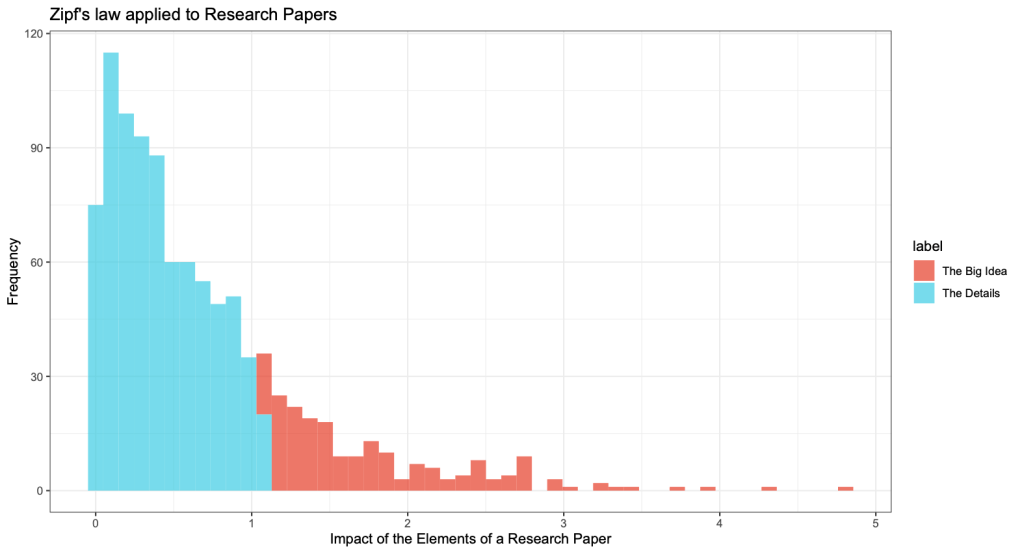
Maybe only 20% of what makes good research are the big things, while the remaining 80% consists of lots of little things. We learn these little things over time, picking up advice from co-authors, tricks in doing our research work, peers’ papers, reviewers during the review process, and many others. For instance, how to set up a project directory, organize code, respond to reviewer letters, structure the introduction, and what a good table looks like.
Even beyond the more conceptual questions, there are also essential implementation questions. For example, how to export a table from Stata or R into a LaTeX document, note the presence or absence of fixed effects inside a regression table, create sideways tables for very long tables, and how to organize a reviewer response document.
This is akin to the work of an artist or a furniture maker. While an artist’s work involves coming up with a new idea for a painting, the artist also needs the technical skills to execute that idea and produce art that matches the original concept. Similarly, the carpenter may have an idea for a new chair, but implementing it into an actual piece of furniture requires paying attention to many details, including cutting each piece of wood, joining them together, sanding each corner, and staining. Our work as researchers also consists of tiny details that can make the difference between an amateurish attempt and a study in craft.
My goal in this book is to distill down the art of social science research into as many little tangible pieces of craft as I have learned over the years. I hope to help you reduce some of the costs of learning the craft part of research and make it easier for you to produce beautiful research papers.
Here is the code for the graph above:
# install and load the required packages
if (!require(“ggplot2”)) {
install.packages(“ggplot2”)
library(“ggplot2”)
}
set.seed(123)
# Generate random data with an exponential distribution
data <- rexp(1000, 1.5)
# Calculate the cutoff point for the top 20% of observations
cutoff <- quantile(data, 0.8)
# Create a data frame with the data and a label for each observation
df = cutoff, “The Big Idea”, “The Details”))
# Create a histogram of the data, colored by the label
ggplot(df, aes(x = value, fill = label)) +
geom_histogram(alpha = 0.7, bins = 50) +
scale_fill_manual(values = c(“#e1341e”, “#1ecbe1”)) +
labs(x = “Impact of the Elements of a Research Paper”, y = “Frequency”, title = “Zipf’s law applied to Research Papers”) +
theme_bw()
 Sharique Hasan