Editing your research
After discussing the structure of an academic paper, the underlying theory, paragraph structure, and how different writers approach sentence structure, it’s time to move on to the next level of writing: focusing on editing each sentence and word to make your point as clear as possible.
Editing papers is the most critical part of the writing process, and numerous quotes attest to this fact. Many authors believe that editing is the most crucial part of writing.
Thankfully, many excellent tools are available today to help us write better, even without formal training as copy editors.
My first paper as an assistant professor was titled “The Mechanics of Social Capital and Academic Performance at Indian College.” This paper was written well before I had many of the tools I now use to write academic papers, and thus was at an earlier stage of my academic training.
The paper went through five or six rounds of review at the American Sociological Review. I am grateful to the editors, reviewers, and anyone else involved for letting this paper get published. While it is a beautiful paper, and I worked very hard on it, it could have been substantially better if I knew what I know now. However, near the end of the review process, the editors suggested I have the paper formally copyedited. I was slightly offended; I had always considered myself a decent writer. Most of my college papers as a philosophy major received positive comments from professors about my writing skills. Now, someone was telling me, “You sound like a foreigner, get your paper edited.” I spoke with one of my colleagues about this, and they recommended that I contract a copy editor who could assist me. They also emphasized that I should not be ashamed to have my papers copyedited, as even the most significant writers have their papers edited dozens of times.
This paper was written before Grammarly was available, so I used Microsoft’s grammar check and software called Grammark. However, nowadays, tools like Grammarly can provide a high-quality read-through of your paper. I use it for everything.
Here are the first few paragraphs of my paper, “The Mechanics of Social Capital and Academic Performance.”
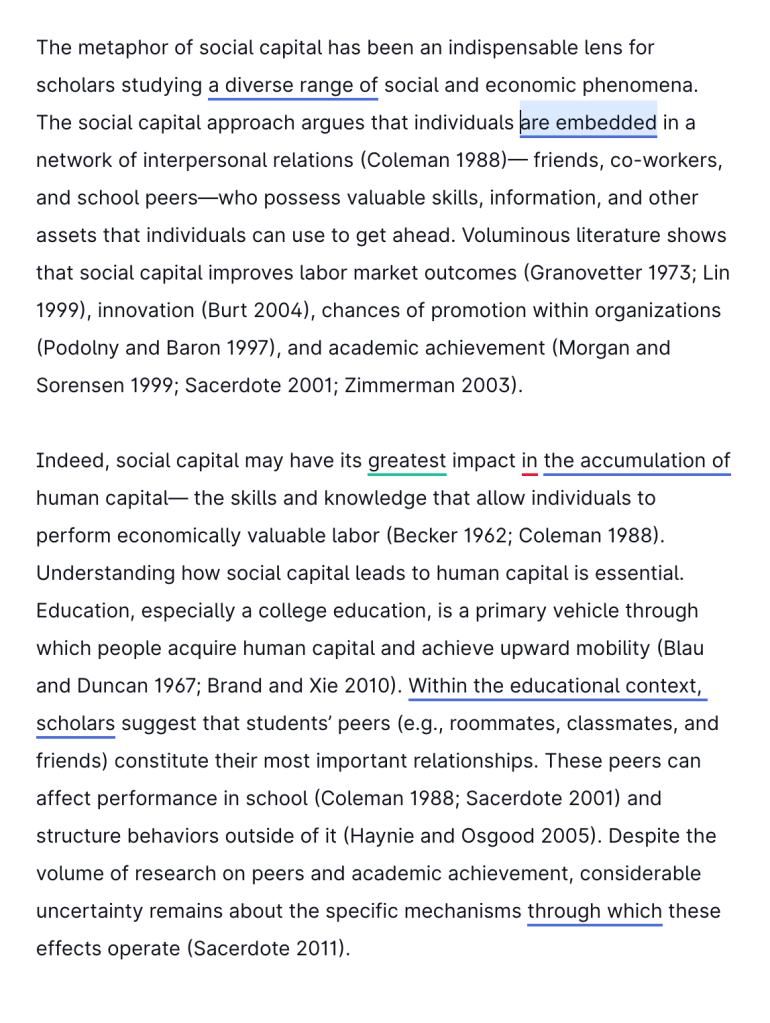
You may notice significant and small opportunities to improve the quality of your writing, and using software like Grammarly can help you do so exceptionally well.
However, Grammarly’s capability to help you think about the broader structure of your argument is limited. This is where the exercises from the previous sections come in handy. These exercises help you understand the point you are trying to make and structure those points at the manuscript’s individual paragraph and section levels.
In addition to using Grammarly, it is worth considering having your manuscript professionally copyedited. Finding a copy editor is easy, and there are various ways to do it, including using collaborators, a copy editor who works on contract for your university, or hiring a copy editor on UpWork. Copyediting services can range from $150 (on UpWork) to sometimes $300-$500 if you use a professional copy editor on contract with a university. While this may seem expensive, remember that your paper will last forever. So, making it as good as possible is worth the cost.
Besides using Grammarly and hiring a copy editor, improving your writing quality is worth investing in. Several excellent books can provide insights into how to write better sentences. I struggle with this aspect of writing the most, as some people can create beautiful sentences, while mine could be more elegant.
As an assistant professor, I found a fantastic book called “The Art of Styling Sentences,” which I worked through. It is a Zipf’s Law toolkit for writing sentences that sound good. Here is another link to the examples of sentences in “The Art of Styling Sentences.”
I also took two classes on Udemy to help me improve my writing.
- Writing with Flair: How To Become An Exceptional Writer
- Ninja Writing: The Four Levels Of Writing Mastery
Both were incredibly useful. I recommend them to all my students.
Although I still write in a similar style to how I used to, I now better understand when my writing needs more clarity. This slight improvement can make a significant difference in the overall quality of my work.
 Sharique Hasan